Why Does My Cat Knock Things Over? The Science Behind the Chaos (And How to Stop It)
It’s 6:47am. I’m not awake yet. Luna is.
From the bedroom, I hear it: the deliberate, unhurried tapping of a paw against my water glass on the nightstand. Tap. Tap. Then — satisfying to her, catastrophic to me — the crash.
If you share your home with a cat, you know this scene. The plant pot that gets nudged off the windowsill. The phone charger that gets batted across the desk. The glass of water — always the glass of water — that gets pushed to the edge, and then over it, with calm, focused intent.
It looks like pure chaos. It looks like spite. It is neither. There is genuine, fascinating science behind why cats knock things over — and once you understand it, you can actually do something about it.
First: Your Cat Is Not Doing This to Annoy You
I know it feels personal. It isn’t. Cats don’t have the cognitive architecture for deliberate revenge the way humans imagine it. What they do have is a set of deeply ingrained instincts, sensory drives, and communication tools — and knocking things over happens to satisfy several of them at once.
Understanding the “why” completely changes how you respond. Instead of frustration, you start to see your cat’s behaviour as a message — one that, once decoded, is surprisingly easy to act on.
7 Real Reasons Cats Knock Things Over
1. They’re Testing Whether It’s Alive
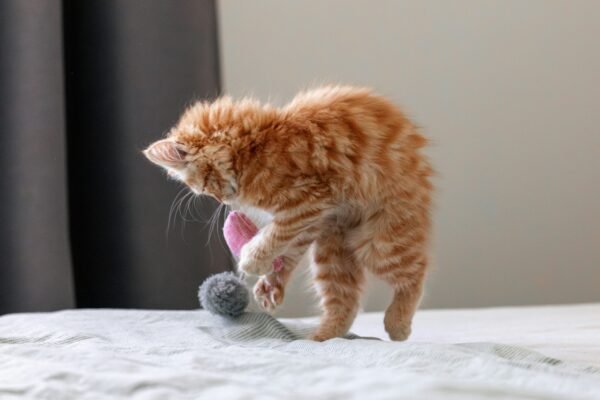
Cats are hardwired hunters. Before a wild cat commits to a pounce, it checks whether prey is alive, injured, or dead — using its paw to prod and test for movement. Your water glass, your phone, your succulent pot on the windowsill: these all get the same investigative treatment.
Luna’s method is textbook predator behaviour: she approaches the object, extends one paw, taps it once lightly. If it moves or makes a sound, she’s confirmed it’s “alive.” If it falls, even better — now she can chase it.
This is also why cats are especially drawn to objects near edges. An object on the edge of a surface is behaviorally similar to prey on the edge of a branch — precarious, about to fall, asking to be pushed.
2. Their Paws Are Extraordinarily Sensitive
A cat’s paws contain a remarkable concentration of nerve receptors — more than almost anywhere else on their body. They use their paws to gather information about texture, temperature, vibration, and movement that their eyes and nose can’t fully detect.
When Luna taps my water glass, part of what she’s doing is reading it. The vibration of the water inside. The coolness of the glass. The way it shifts when touched. It’s genuinely sensory exploration — the feline equivalent of picking something up to examine it more closely.
This is especially true of objects with interesting tactile properties: plants with textured leaves, ceramic pots, glasses with condensation on them, anything that vibrates or hums faintly.
3. They’re Bored — and You’re the Entertainment
Here’s the uncomfortable truth for devoted cat owners: your cat may be knocking things over because it’s the most interesting thing that happens in their day.
Cats need mental stimulation. An indoor cat with nothing to hunt, explore, or problem-solve will manufacture stimulation from whatever’s available — and pushing objects off surfaces is genuinely rewarding. The object moves. It makes a sound. It falls. And then you come running, make noise, and give them attention. From the cat’s perspective, this is a spectacular outcome.
If your cat knocks things over primarily when you’re busy, ignoring them, or in another room, boredom is almost certainly the driver. The solution isn’t scolding — it’s enrichment. A well-chosen cat tower or dedicated play sessions can redirect this energy into more appropriate outlets.
4. They’re Asking for Attention — Specifically
Cats learn cause and effect faster than most owners realise. If knocking the glass off the nightstand at 6:47am reliably produces a response from you — any response, even “LUNA, NO!” — your cat has learned that this behaviour works.
This is operant conditioning: your cat performed a behaviour, it produced a result (your attention), and so the behaviour gets repeated. Luna doesn’t need you to be happy about it. She needs you to react. And you do, every single time.
The fix for attention-seeking knocking is counterintuitive: ignore it completely. Don’t speak, don’t react, don’t even make eye contact. Any response — including negative ones — reinforces the behaviour. It takes consistency, but cats do stop doing things that produce no result.
5. They’re Marking Their Territory
Cats have scent glands in their paw pads. When a cat taps, pushes, or rubs an object, they’re depositing a scent marker — claiming it as part of their territory. This is particularly common with new objects in the home: a new plant, a new decorative pot, a new book left on the coffee table.
The knocking is often secondary — first comes the investigation, then the scent-marking tap, and if the object happens to be near an edge, gravity does the rest. Your cat isn’t targeting your things; they’re investigating and claiming them.
This matters especially when you bring new indoor plants into the home. A new pot on a windowsill is prime investigation territory. Expect your cat to tap, sniff, and test it thoroughly in the first 24–48 hours — which is another strong reason to make sure any new plant is non-toxic before it arrives.
6. They Love the Physics of It
This one is harder to prove scientifically but deeply apparent to anyone who has watched a cat knock the same object off the same surface repeatedly: some cats simply enjoy the falling.
The movement, the sound, the cause-and-effect satisfaction of a tap producing a fall — these seem to be intrinsically rewarding for many cats. It’s play. Unstructured, slightly destructive play that costs you a knocked-over plant and costs them nothing.
Cats who do this repeatedly with the same object, in the same spot, when they aren’t hungry or attention-seeking, are almost certainly in this category. The good news: these cats are usually the easiest to redirect with toys that provide the same falling/moving satisfaction — like crinkle balls, feather wands, or a good old-fashioned empty cardboard box.
7. They Have a Medical Issue Worth Checking
This one matters and often gets overlooked. A sudden increase in knocking behaviour — particularly in a cat who hasn’t done it much before — can occasionally indicate a vision or neurological issue. Cats with deteriorating vision may tap and test objects more because they can’t see them clearly. Cats with vestibular issues (inner ear problems) can seem clumsy and disoriented, knocking things over without intent.
If your cat’s knocking behaviour has changed suddenly, if they seem confused or disoriented, or if it’s accompanied by other unusual behaviours, a vet check is warranted. Most of the time it won’t be anything serious — but it’s worth ruling out.
The Plant Problem: Why Cats and Windowsill Plants Are a Dangerous Combination
If you’re a plant owner, all of the above has a very specific implication: your cats and your houseplants are on a collision course.
Windowsills are prime real estate for cats — elevated, warm, with a view. They’re also where a lot of us keep our plants. A cat exploring a windowsill plant is doing several things simultaneously: checking it’s not alive (prey-testing), marking it with scent, exploring its texture, and — if it’s near an edge — possibly nudging it to watch it fall.
This is why the combination of cats and toxic plants is genuinely dangerous, not just theoretically. A peace lily, a pothos, or an aloe vera on a windowsill will eventually get investigated, knocked, and possibly chewed. If you have cats who knock things over — which is most cats — please check every plant in your home against the ASPCA’s toxicity database before keeping it at reachable height.
Our guide to 10 beautiful pet-safe indoor plants is a good starting point for rebuilding your plant collection with cat safety in mind.
How to Actually Stop Your Cat Knocking Things Over
Now that you know the why, here’s what actually works. Notice that “shout at the cat” is not on this list — because it doesn’t work, and often makes it worse by providing the attention reward.
Remove the Temptation
The most effective short-term solution: clear surfaces of anything your cat repeatedly targets. An empty surface can’t be knocked. It’s not a permanent solution, but it breaks the habit loop while you work on the underlying cause.
For plants specifically, move them to surfaces your cat genuinely can’t reach — high shelves, hanging planters, or rooms your cat doesn’t access. Heavy terracotta and ceramic pots are much harder to knock than lightweight plastic ones. Blu-Tack or museum putty under pot bases adds extra stability.
Add Enrichment — Aggressively
If boredom is the driver, the fix is straightforward: give your cat more to do. A cat tower near a window provides elevated territory, a view, and a scratching outlet. Puzzle feeders make mealtimes cognitively demanding. Wand toy sessions twice a day — five minutes each is enough — burn hunting energy in an appropriate direction.
I added a cat tower to Luna’s room and started doing two five-minute wand sessions per day. The nightstand knocking dropped by about 80% within two weeks. Not zero — Luna is Luna — but dramatically reduced.
Don’t React to Attention-Seeking Knocking
This requires genuine discipline. When Luna knocks something over at 6:47am, I now do nothing. I don’t look at her. I don’t speak. I wait until she’s walked away, then quietly pick it up. The behaviour hasn’t stopped entirely, but it has reduced — because she’s learned it doesn’t reliably produce me.
Reward the behaviour you want instead: when she comes to sit next to me calmly in the morning, she gets enthusiastic attention. She’s gradually learning that calm proximity works better than knocking.
Provide Sanctioned “Knocking” Outlets
This is the most underused solution and one of the most effective. Give your cat objects they’re allowed to knock. A crinkle ball on the floor. A lightweight toy on a low shelf they can push off repeatedly. A shallow box with objects inside to paw at.
Cats don’t need to stop knocking things over — that’s an unrealistic ask. They need an appropriate outlet for a completely natural instinct. Give them one, and your water glass stops being the most interesting object in the room.
Establish a Morning Routine Before They Ask
Many cats knock things over in the morning because that’s when their biological clock says it’s time to hunt — and you’re asleep instead of feeding them. Try feeding your cat with an automatic feeder that dispenses at their natural wake time. Or set a consistent feeding alarm and beat them to it. A cat who’s already been fed by the time they’d normally start demanding attention has less reason to escalate.
I use a timed feeder set for 6:30am. Luna still comes to check on me at 6:47, but since she’s already eaten, the urgency is gone. The glass stays on the nightstand. Mostly.
What Your Cat Is Actually Saying
Zoom out for a moment. A cat who knocks things over is a cat who is engaged, curious, and — in their own chaotic way — communicating. They’re hunting, or exploring, or bored, or hungry, or just delighted by physics. None of these are personality flaws. They’re all very normal expressions of being a cat.
The cats who knock things over obsessively and seem unable to stop are usually the most intelligent, most engaged cats — the ones who need the most stimulation and who thrive most dramatically when you provide it. Luna is evidence of this. She’s exhausting and she’s wonderful and the two things are directly connected.
Once you understand what she’s telling you, you can answer back — with enrichment, with routine, with appropriate outlets — and the chaos gradually becomes something more like a conversation.
About Maya Chen: Maya is a Los Angeles-based pet owner and plant enthusiast with 8+ years of experience keeping cats, a rescue dog named Mango, and 30+ houseplants under one roof — most of them still intact. Questions? hello@petsnplants.net