Dog Enrichment: 10 Simple Activities That Will Transform Your Dog’s Behavior and Happiness
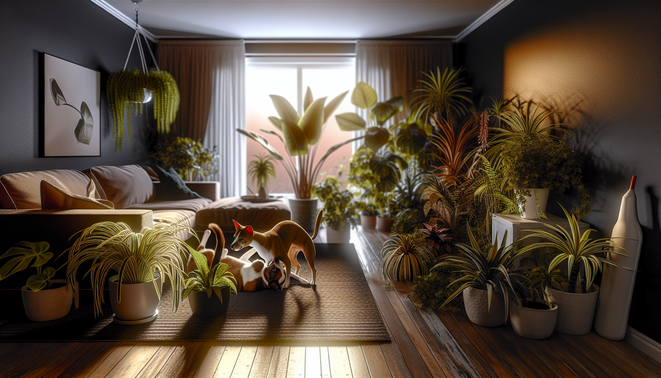
For the first three weeks after I adopted Mango, he destroyed two pot plants, chewed through a charging cable, and barked so much my neighbour left a note. I thought I was doing something wrong. I was walking him twice a day. He had toys everywhere. He had a comfortable bed, good food, and a house full of love.
What Mango didn’t have was enough mental stimulation. A tired dog and a mentally fulfilled dog are two completely different things — and once I understood that, everything changed.
Dog enrichment is one of the fastest-growing areas of pet care, and for good reason. Rescue dogs in particular — dogs who’ve experienced uncertainty and upheaval — benefit enormously from enrichment routines that give them a sense of agency, purpose, and calm. But every dog, from puppies to seniors, thrives when their brain gets a real workout.
Here are the 10 enrichment activities that transformed Mango from a chaos machine into a calm, confident dog — and how to do each one at home.
What Is Dog Enrichment (And Why Does It Matter)?
Enrichment is anything that engages your dog’s natural instincts — sniffing, foraging, problem-solving, chewing, exploring, and socialising. A dog that gets enrichment isn’t just entertained; they’re fulfilling deep biological drives that domestic life often leaves unsatisfied.
The results of consistent enrichment are striking. Studies from the field of animal behaviour show that dogs given regular mental stimulation exhibit significantly fewer destructive and anxious behaviours. They sleep more soundly, recover faster from stressful situations, and are generally easier to train.
Maya’s observation: After two weeks of daily enrichment with Mango, the neighbour’s note stopped. After a month, he was sleeping through the night for the first time. It wasn’t magic — it was mental exhaustion, and it was glorious.
The 5 Types of Dog Enrichment
Before we get into the activities, it helps to understand the five categories of enrichment, so you can make sure your dog gets a good mix:
- Sensory — engaging smell, sight, sound, taste, touch
- Cognitive — problem-solving, puzzle toys, training
- Social — interaction with people, other dogs, new environments
- Physical — movement that goes beyond a regular walk
- Food-based — making your dog work for their meals
The activities below cover all five. Aim for at least two or three types per day for a genuinely well-rounded routine.
10 Dog Enrichment Activities to Start This Week
1. The Snuffle Mat
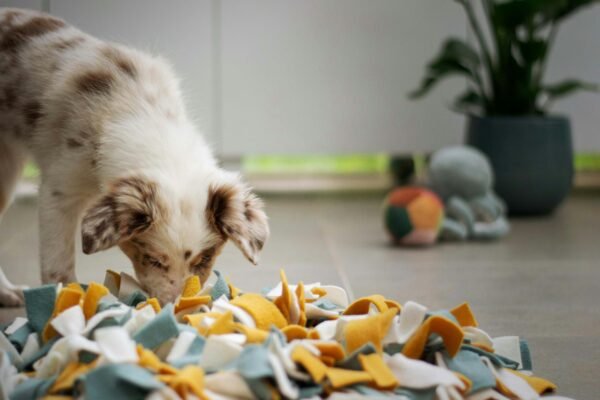
This was my first enrichment purchase and still one of my favourites. A snuffle mat is a mat with fabric strips woven through it that you hide dry kibble or treats inside. Your dog uses their nose to sniff out every hidden piece — which can take 10 to 20 minutes and leaves them utterly satisfied.
Dogs have up to 300 million olfactory receptors compared to our 6 million. Sniffing is genuinely cognitively taxing for them in a way that simply running around isn’t. A 20-minute snuffle mat session can tire Mango out more than a 45-minute walk.
How to use it: Scatter a handful of kibble across the mat, let your dog work for it. Start easy so they understand the concept, then bury treats deeper as they get skilled.
Cost: $15–30 on Amazon. Or make your own by threading fleece strips through a rubber mat with holes.
2. Scatter Feeding in the Garden (or Indoors)
Instead of serving dinner in a bowl, scatter your dog’s entire kibble portion across the grass or a patch of floor. This transforms a 30-second meal into a 15-minute foraging session. Free, immediately available, and deeply satisfying for any dog with a nose.
I do this on my balcony where I keep my container plants — Mango snuffles through the pots looking for kibble, the plants don’t mind, and he ends up flopped on his side for an hour afterwards. A bonus: sniffing near plants stimulates curious, exploratory behaviour that helps anxious dogs relax.
Best for: Anxious dogs, rescue dogs, dogs who eat too fast, any dog on a budget.
3. Frozen Kongs and Lick Mats
The Kong is a hollow rubber toy you stuff with food and freeze. The lick mat is a flat mat with ridges you spread soft food across. Both work on the same principle: slow, sustained licking and chewing releases serotonin and reduces cortisol in dogs. It is, in the most literal sense, calming.
I use Mango’s frozen Kong whenever I need to do a video call, when we have visitors he finds overstimulating, or when I’m doing plant repotting and need him occupied and calm for 30 minutes.
Good fillings: Plain yoghurt + blueberries, mashed banana, peanut butter (xylitol-free), cooked sweet potato, bone broth. Freeze overnight for maximum duration.
Important: Always check ingredients. Xylitol, grapes, raisins, and macadamia nuts are toxic to dogs — the same careful approach you’d apply to any pet’s safety around household items.
4. Puzzle Feeders and Treat Dispensers
Puzzle feeders come in a huge range of difficulty levels — from basic sliders that even puppies can figure out, to multi-step puzzles that challenge Border Collies. The principle is always the same: your dog has to manipulate the toy to release food.
Start at level 1 and work up. A dog that’s given a puzzle too hard too early gets frustrated and gives up — the opposite of enrichment. A dog that masters level 3 after working up through levels 1 and 2 has built genuine problem-solving confidence.
Top picks: Outward Hound Nina Ottosson puzzles (levels 1–4, widely available), Kong Wobbler treat dispenser, Trixie Activity Board.
5. The “Find It” Nose Work Game
This is the easiest enrichment game to teach and one of the most powerful. Hide treats around a room while your dog waits, then release them with “find it!” and watch them work. Start with visible treats and progress to hiding them inside shoes, under cushions, or behind plant pots.
I play this daily with Mango. He’s now so skilled that I can hide 20 pieces of kibble around my living room — including behind my snake plant and under the edge of the sofa — and he finds every single one. It’s extraordinary to watch.
Why it works: Dogs process scent information in a part of the brain associated with pleasure and reward. Nose work essentially puts your dog in a state of focused, happy concentration — what behaviourists call “calm arousal.”
6. Training Sessions (Short and Frequent)
Five-minute training sessions three times a day are more effective than a single 30-minute session — and far more enriching. Short sessions keep your dog engaged rather than fatigued, end on a success, and build a vocabulary of commands that gives your dog mental structure.
Go beyond sit and stay. Teach “left paw,” “right paw,” “spin,” “touch” (nose to hand), “back up,” or the names of their toys. A dog that knows 20 commands has 20 ways to communicate with you and 20 reasons to pay attention. That’s not just enrichment — it’s a relationship.
Tool tip: Use a clicker for precision and a treat pouch so rewards are immediate. Short interactive play sessions between training sets keep energy balanced.
7. Sniff Walks (Not Pace Walks)
A “sniff walk” is a walk where your dog sets the pace and you follow their nose. Instead of covering 2km in 20 minutes, you cover 500 metres in 30 minutes because your dog spends 3 minutes sniffing one lamppost. And that is fine. That is, in fact, the point.
The information a dog gets from sniffing a single lamppost — which dogs have been there, their sex, their health status, when they passed by — is cognitively equivalent to reading a detailed news bulletin. A sniff walk gives your dog a rich picture of the world. A pace walk just gives them exercise.
Research from the University of Agricultural Sciences in Sweden found that dogs who were allowed to sniff freely on walks showed lower pulse rates and were more optimistic in subsequent cognitive tests than dogs walked at their owner’s pace.
How to shift: Use a longer lead — at least 5 metres — so your dog has room to explore without you hovering. Say “go sniff” as a release cue, and resist the urge to hurry them along.
8. Chew Time
Chewing is a self-soothing behaviour for dogs. Dogs who don’t have appropriate things to chew will find inappropriate ones — your furniture, your charging cables, your favourite plant pots. Providing a daily chew is both enrichment and prevention.
The best chews are natural and long-lasting: raw beef bones (always supervise), bully sticks, yak chews, deer antlers, or dried tendons. Avoid rawhide, which can swell in the stomach, and chews small enough to be swallowed whole.
I give Mango a bully stick every evening after dinner. He chews for 20–30 minutes, then goes straight to sleep. It has become his favourite part of the day and my most reliable wind-down tool.
9. New Environments and Novel Experiences
Dogs need novelty the same way humans need new experiences to stay mentally sharp. Taking your dog somewhere new — a different park, a pet-friendly hardware store, a quiet beach — gives their brain a flood of new sensory data to process. It builds confidence, reduces reactivity, and satisfies their drive to explore.
You don’t need to travel far. Drive to a new neighbourhood and do your sniff walk there. Visit a pet-friendly garden centre. Walk past a building site (the sounds and smells are fascinating for dogs). Let your dog explore a friend’s garden. Even rearranging your furniture gives your dog’s nose something genuinely new to investigate.
For shy or anxious dogs: Introduce new environments at a distance first. Let them observe from a comfortable spot before moving closer. Never force interaction. Progress at their pace.
10. The Muffin Tin Game
This is the enrichment activity I recommend to every new dog owner because it costs nothing and takes 30 seconds to set up. Put a treat in each cup of a 12-cup muffin tin. Place a tennis ball on top of each cup. Let your dog figure out that they need to remove the balls to access the treats.
Most dogs work this out within 60 seconds on their first try. After a few sessions, they’ve memorised the game but still find it deeply satisfying. The combination of problem-solving and reward hits exactly the same neural pathways as hunting — which is, after all, what domestic dogs evolved from.
Upgrade it: Hide the treat under only some of the balls. Or put the balls in random cups rather than all of them. The slight unpredictability makes it even more engaging.
Building a Daily Enrichment Routine
You don’t need to do all 10 every day. A simple rotation works brilliantly:
- Morning: Scatter feeding instead of a bowl + short training session (5 mins)
- Midday: Frozen Kong or lick mat while you work
- Afternoon walk: Sniff walk with a long lead
- Evening: Muffin tin game or puzzle feeder + bully stick wind-down
That routine takes less than an hour of your active time spread across the day, and it produces a dog who is calm, bonded, and genuinely content. I’ve been doing a version of this with Mango for over a year. The difference compared to where we started is night and day.
Signs Your Dog Needs More Enrichment
If you’re unsure whether your dog needs more mental stimulation, watch for these signs:
- Destructive chewing of furniture, shoes, or plants
- Excessive barking, especially when you’re home
- Hyperactivity that doesn’t settle even after exercise
- Attention-seeking that escalates into nipping or jumping
- Lethargy and disengagement — enrichment matters for understimulated quiet dogs too
- Repetitive behaviours like pacing, spinning, or tail chasing
Any of these is your dog communicating that something is missing. Enrichment is almost always part of the answer.
A Note on Indoor Plants and Dog Enrichment
Since we’re a pets-and-plants household here, one thing worth flagging: scatter feeding and nose work games near your houseplants can result in curious dogs investigating the pots, digging in soil, or occasionally chewing leaves. This is manageable — but it’s another reason to make sure all your indoor plants are pet-safe.
Check out our complete guide to 10 pet-safe indoor plants to make sure your enrichment space is a safe one. And if you’re doing scatter feeding outdoors near container plants, our guide to container gardening has tips on keeping plants protected from enthusiastic sniffers.
Final Thoughts
Dog enrichment changed my relationship with Mango. Not because it fixed him — he wasn’t broken — but because it finally gave him what he needed to settle into our life together. He’s calmer, more focused, more affectionate, and genuinely happier than the dog who arrived eight months ago and ate my charging cable.
Start with one activity this week. The snuffle mat or the muffin tin game — whichever appeals most. Watch what happens. Your dog will tell you, through tail wags and focused sniffing and that deeply satisfied post-enrichment nap, that this is exactly what they’ve been waiting for.
About Maya Chen: Maya is a Los Angeles-based pet owner and plant enthusiast with 8+ years of experience keeping cats, a rescue dog named Mango, and 30+ houseplants under one roof. Questions? hello@petsnplants.net